

![IMG_5500[12201]](https://globalhumanitarianism.com/wp-content/uploads/2017/08/img_5500122011.png?w=685) I recently had the honor of serving on the Uchaguzi team for the elections that just concluded in Kenya. Uchaguzi is a mapping and events platform that runs on the Ushahidi (Swahili for ‘testimony’ or ‘evidence’) open sourced software system. It crowd sources input from the field via Twitter feeds, Facebook messenger links, and SMS in order to get a true picture of voting processes, inhibit election fraud, create an aura of oversight, and serve as a central repository for violence and security issues. Ushahidi was originally developed in the Kenyan 2008 deadly riots and has subsequently served in over a hundred governance, humanitarian, and crisis situations around the globe. This successful platform and other recent similar breakthroughs have given the capital of Kenya the nickname of the “Silicon Savannah.”
I recently had the honor of serving on the Uchaguzi team for the elections that just concluded in Kenya. Uchaguzi is a mapping and events platform that runs on the Ushahidi (Swahili for ‘testimony’ or ‘evidence’) open sourced software system. It crowd sources input from the field via Twitter feeds, Facebook messenger links, and SMS in order to get a true picture of voting processes, inhibit election fraud, create an aura of oversight, and serve as a central repository for violence and security issues. Ushahidi was originally developed in the Kenyan 2008 deadly riots and has subsequently served in over a hundred governance, humanitarian, and crisis situations around the globe. This successful platform and other recent similar breakthroughs have given the capital of Kenya the nickname of the “Silicon Savannah.”
In the recently concluded August 2017 election I co-managed the Research and Analysis team (which sounds neat but the Mapping Team and Verification Teams were pretty amazing) along with the energetic and passionate Nairobi based digital humanitarian Hazel Mugo. The other institutional partners in the Uchaguzi effort were CRECO and Infonet. We are still processing the last vestiges of these August 8th elections and will be coming out with more insights over the next few weeks. (That is a long way of saying that the one hundred global digital volunteers need to catch up on their sleep!) You can learn more about the Uchaguzi technology and history here. Here is an example of the output of the mapping facility from a past election:
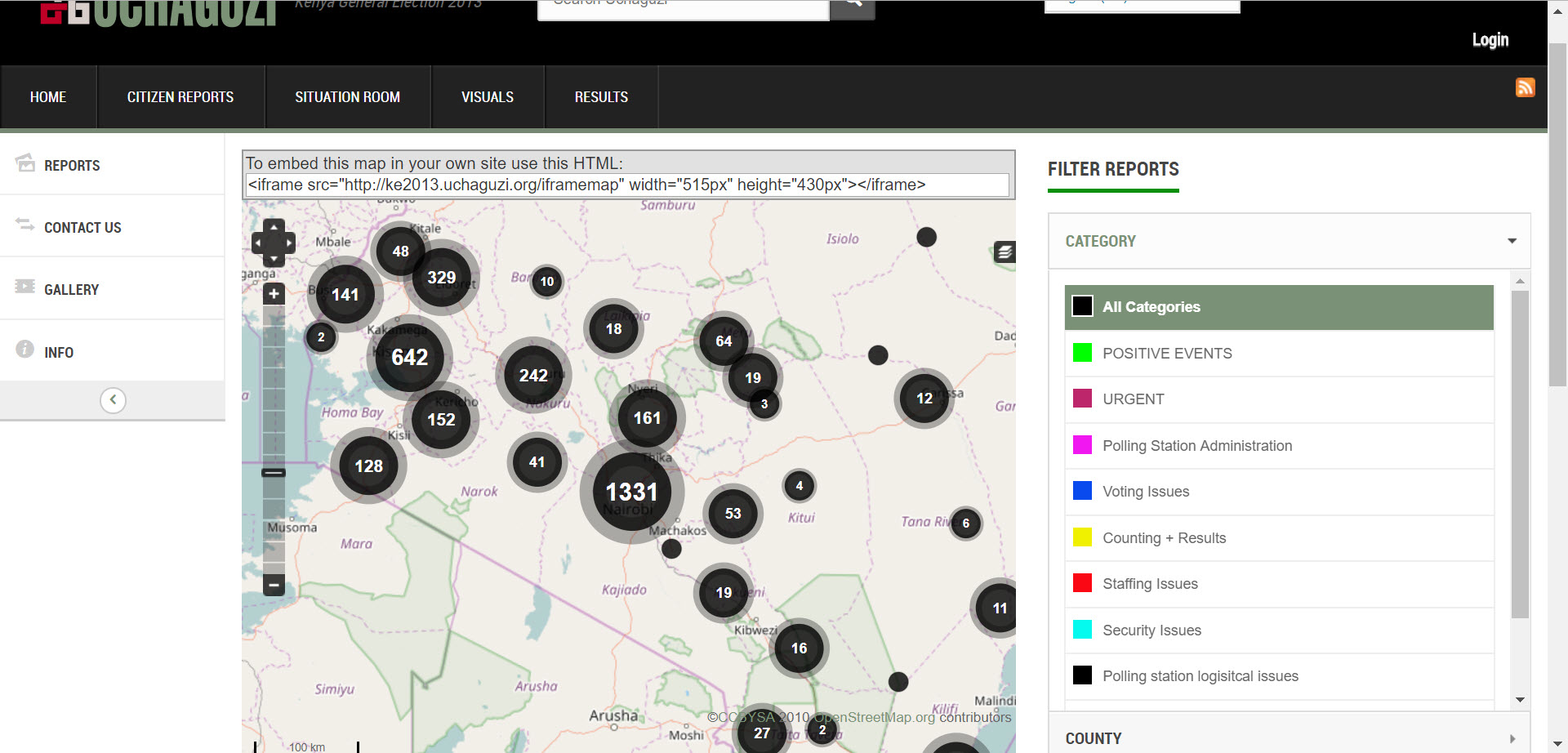
Future blogs will go through the new results, analysis, and learnings in great detail. But before getting into the weeds, I would today like to spend some cognitive surplus on theory. What are the affordances of Twitter in governance and humanitarian crisis? Do users expect the same utility from Facebook Messenger as they do with a tweet or from a standard SMS text? Does the sum of the crowd input have less bias then mainstream media reporting? Is the Theory of Affordances, originally developed by Psychologist James Gibson, even the right lens by which to evaluate the mechanisms and the outcomes?
To help inform these critical grounding questions I have enrolled in the Survey of Digital & Social Media graduate course at Kennesaw State University, taught by Dr. Laura Beth Daws. Ironically, in an initial assignment paper authored by danah m. boyd (lower case intended), titled Social Network Sites; Definition, History, and Scholarship, the author immediately notes the plethora of affordances that are possibly applicable with Social Networking Sites. The full text of her very insightful, top-down, perspective can be viewed here. I look forward to the course assisting both me and you, dear reader, in identifying the connections between conflict mitigation applications and social networking theory. Additionally, the class may help to determine coherent and academically defensible structures by which to process and analyze crowd sourced events data delivered via social media. The critical value of these burgeoning humanitarian applications was highlighted this week when Ushahidi actually had to be rolled out here in the US under the DocumentHate moniker in order to help evaluate the surge of domestic hate group activity (see press release).
Stay tuned!
 Humanitarianism Unleashed